Menu
Your Cart

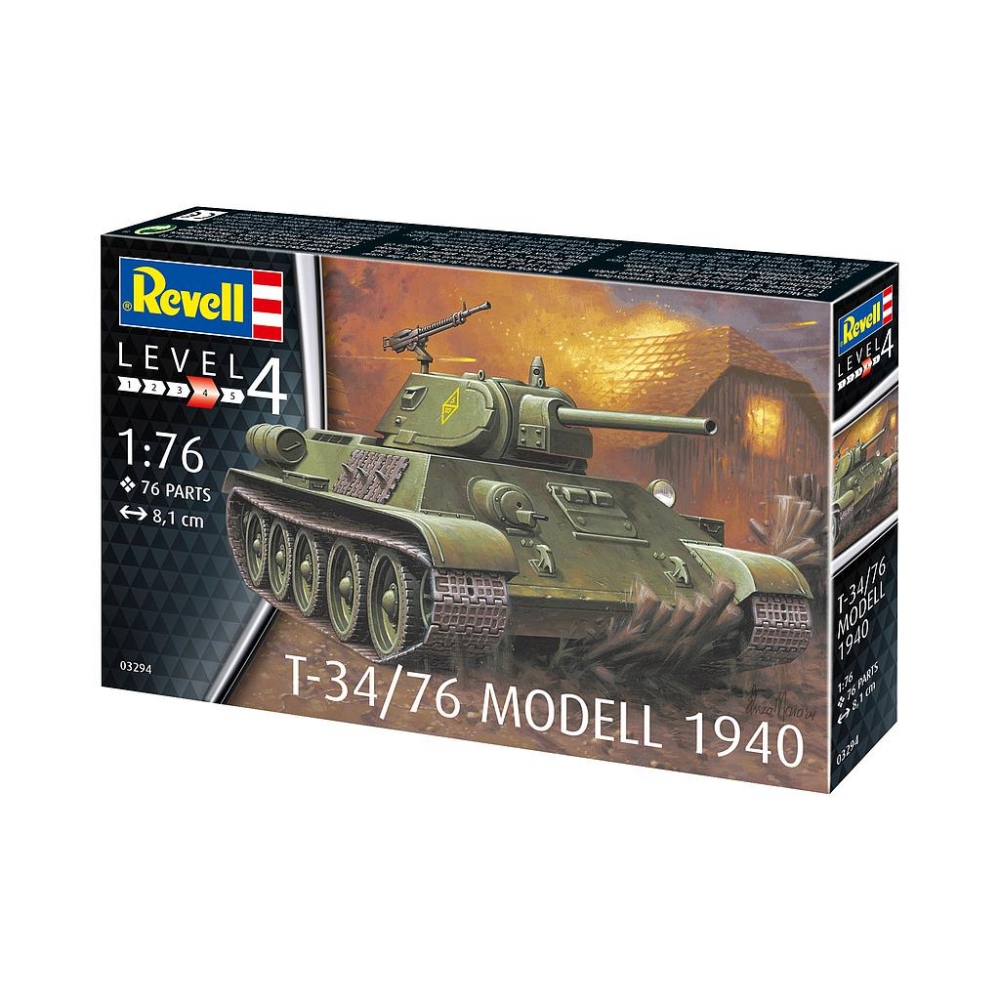
Assembled model Soviet tank T-34/76 Model 1940, 76 parts

Сглобяем модел Съветски танк T-34/76 Модел 1940, 76 части
Assembled model Soviet tank T-34/76 Model 1940, 76 parts
12.20€ (23.86лв.)
  • Stock: In Stock
  • Brand: Revell
  • Product code: SB-R03294
✨ MagicAI: Last inventory update: 26-04-2026
Expected delivery date : Monday 27 April 2026 - Wednesday 29 April 2026

*Dates are valid only for deliveries in Bulgaria. For EU deliveries dates may vary
Fast delivery
95% of orders arrive within one day.
Quality
Our products are best quality
Convenient payment
With card, Apple Pay/Gpay, or by bank transfer
Possible return
14 days in case something is wrong.

Description

Assembled model, Revell, Soviet tank T-34/76 Model 1940, 76 parts

R03294


23.90

Gender: M
Age: over 8 years.
The T-34 is a Soviet medium tank of World War II and the post-war period.

The first prototypes were built in 1937-1940, and serial production in the USSR took place in 1940-1957. During its course, about 84,000 vehicles of this type were built, making the T-34 one of the most produced tanks in the story! Propulsion was provided by a single 500 hp V-2-34 engine. The length of the car - in the T34 / 76 version - was 6.68 m, with a width of 3 meters. Armament consists of a 76.2 mm F-34 cannon and two 7.62 mm DT machine guns. The main armament in the T-34/85 version is the ZIS-S-53 85 mm gun.

The T-34 is undoubtedly one of the most famous tanks in the history of both the Second World War and the army as a whole, representing a specific symbol of the Soviet victory in the war with the Third Reich. The vehicle was developed for the needs of the Red Army as a successor to the so-called pursuit tanks of the BT series (BT-5 and BT-7), but also to the T-26 tank. Work on the car began in 1937 in a special design bureau of the Kharkov Steam Engine Plant. Initially, the work was led by engineer Adolf Dick (he also made the first sketches of the new car), and after his arrest by the Soviet security authorities, the work was led by Mikhail Koshkin. The vehicle was originally designated as the A-20. However, a second prototype (A-32) was quickly built with a primary armament in the form of a 76.2 mm gun and much thicker frontal armor. The final prototype was finally accepted for production. It can be assumed that when it entered service, the TT-34 was a very successful tank in many ways. It was characterized - as in 1940 - by a very strong weapon, had well-profiled armor based on inclined armor plates, as well as very high mobility and off-road driving qualities. The disadvantages include the very poor ergonomics of the car or the poor optics used in the first production batches. Despite these shortcomings, when the T-34 appeared on the Eastern Front, the German troops were greatly surprised by it. The high general evaluation of the T-34 and its fighting qualities determined its mass production and its transformation into the main tank of the Red Army during the fighting of 1942-1945. They also led to further improvements to the structure, for example in 1942 the a new hexagonal tower appears, which improves the quality of work of crew members with the commander's cupola. The engine and gearbox were also improved. However, in 1944 the T-34/85 model entered service, with a completely new triple turret and main armament in the form of an 85 mm gun. The T-34 tank participated in almost all major battles fought between the Red Army and the Wehrmacht on the Eastern Front in 1941-1945: starting with the Battle of Moscow, through the Battles of Stalingrad and Kursk, Operation Bagration and the capture of Berlin. After 1945, the T-34 tank was still in service, it was also widely exported outside the USSR to countries such as Czechoslovakia, Poland, East Germany, Hungary and Syria. The engine and gearbox were also improved. However, in 1944 the T-34/85 model entered service, with a completely new triple turret and main armament in the form of an 85 mm gun. The T-34 tank participated in almost all major battles fought between the Red Army and the Wehrmacht on the Eastern Front in 1941-1945: starting with the Battle of Moscow, through the Battles of Stalingrad and Kursk, Operation Bagration and the capture of Berlin. After 1945, the T-34 tank was still in service, it was also widely exported outside the USSR to countries such as Czechoslovakia, Poland, East Germany, Hungary and Syria. The engine and gearbox were also improved. However, in 1944 the T-34/85 model entered service, with a completely new triple turret and main armament in the form of an 85 mm gun. The T-34 tank participated in almost all major battles fought between the Red Army and the Wehrmacht on the Eastern Front in 1941-1945: starting with the Battle of Moscow, through the Battles of Stalingrad and Kursk, Operation Bagration and the capture of Berlin. After 1945, the T-34 tank was still in service, it was also widely exported outside the USSR to countries such as Czechoslovakia, Poland, East Germany, Hungary and Syria. The T-34 tank participated in almost all major battles fought between the Red Army and the Wehrmacht on the Eastern Front in 1941-1945: starting with the Battle of Moscow, through the Battles of Stalingrad and Kursk, Operation Bagration and the capture of Berlin. After 1945, the T-34 tank was still in service, it was also widely exported outside the USSR to countries such as Czechoslovakia, Poland, East Germany, Hungary and Syria. The T-34 tank participated in almost all major battles fought between the Red Army and the Wehrmacht on the Eastern Front in 1941-1945: starting with the Battle of Moscow, through the Battles of Stalingrad and Kursk, Operation Bagration and the capture of Berlin. After 1945, the T-34 tank was still in service, it was also widely exported outside the USSR to countries such as Czechoslovakia, Poland, East Germany, Hungary and Syria.

Scale: 1:76
Length of finished model: 8.1 cm
Difficulty level: 4
Material: plastic
Assembly and painting required